Viking Range Repair
Viking Ignition Faults in Boston: Spark, Gas or Something Wet
A Viking burner that clicks without lighting is usually mechanical rather than electrical — a cap sitting proud, a blocked port, or moisture left across the electrode after cleaning. If you can smell gas and it does not clear, leave the building and call the utility first.
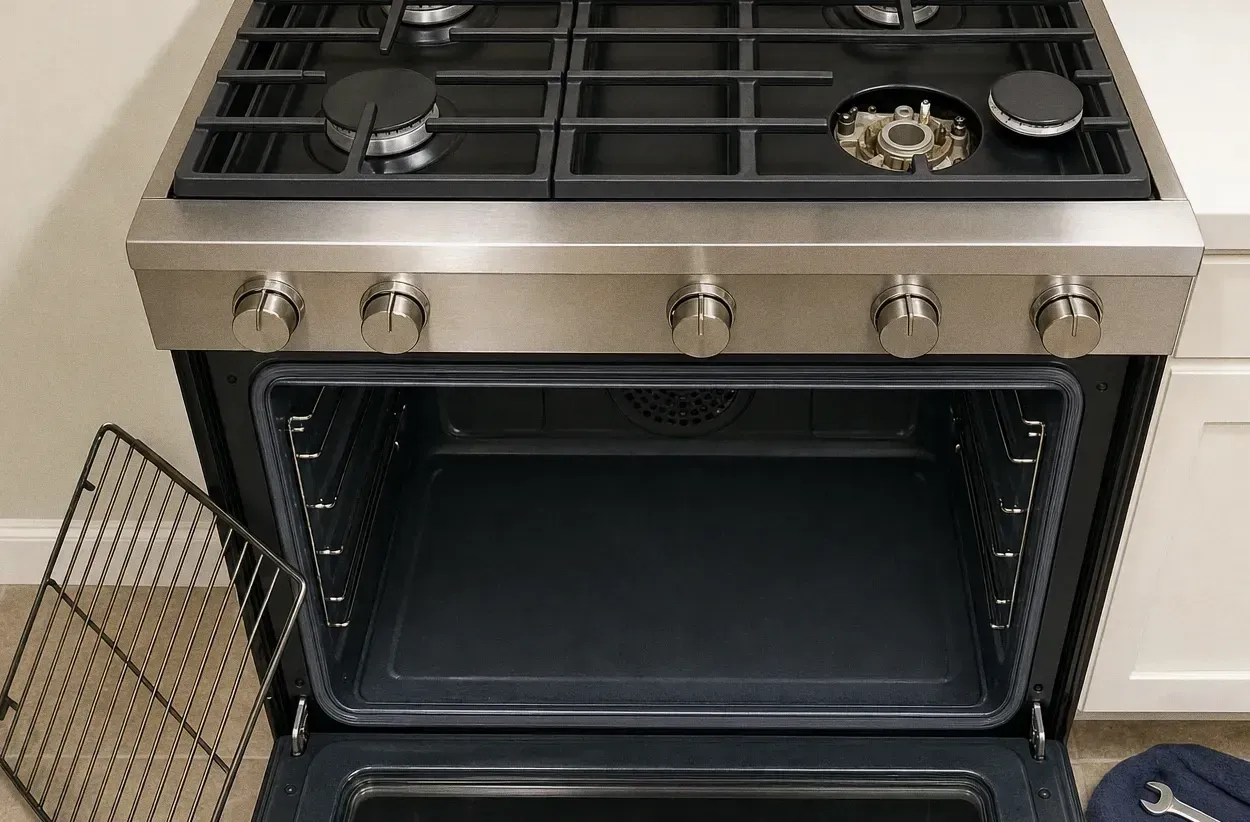
One thing before anything else, because it is not a troubleshooting question. Everyone leaves the building, and the gas utility gets telephoned from outside, whenever you can smell gas and the smell does not clear. Do not hunt for the source, do not operate switches, and do not ring a repair company first. Everything below assumes the air in the kitchen is clean.
With that said, the most common version of this complaint has a date attached to it: the burner worked on Saturday, the top was cleaned on Sunday, and since Sunday it has clicked without lighting. That sequence is so frequent it is worth treating as the leading hypothesis until something contradicts it.
The question that halves the problem
Before touching a single part, establish how much of the top is affected. A fault on one burner while the others behave normally lives in that burner’s cap, its ports or its electrode. A fault across every burner points instead at the module, the supply or the earth. And clicking that continues with all the knobs in the off position is a third thing entirely, unrelated to whether anything lights.
The click itself is evidence of exactly one fact: the spark generator is working. It says nothing whatever about whether gas has arrived at the port. People hear the ticking and conclude the ignition side must be healthy, then start looking at valves; half the time the ticking is the only healthy thing in the sequence.
Expect the ticking to be general. On most ranges a single module feeds all the electrodes at once, which is why one knob makes the whole cooktop tick. That is normal behaviour and not a symptom in its own right.
Write four things down before you begin: which burners are affected, whether they eventually catch, what you were doing in the hours beforehand, and whether anything was spilled or washed. In an East Boston triple-decker where a 30-inch professional range has been fitted into an opening that was never sized for one, that last question matters more than usual — cleaning around a tight fit means water goes places it would not otherwise go.
The mechanical checks, which are most of the answer
Most non-lighting burners are solved with your hands rather than a meter. A cap that sits a fraction proud, a port with cooked spillage in it, or a film of water still bridging the electrode will each stop a burner lighting while the spark carries on looking perfect.
Start with the cap. It has to sit down flat and fully home; a cap resting a millimetre high changes the path gas takes as it leaves the burner and can move the mixture out of reach of the spark entirely. The way to confirm seating is by comparison, not by eye — lift the cap off a burner that works, set it down again, feel how it drops and whether it rocks, then repeat the same movement on the failed one. Your hands will find a difference your eyes will not.
Ports next. Boil-over bakes onto the ring and blocks individual ports, and a burner missing its ports nearest the electrode will spark into empty air. Clear them with a soft brush or a wooden point once the burner is stone cold. Never open one out with a drill bit, a needle or anything else that removes metal; the port size is not yours to change.
Then moisture, which is the reason so many of these faults follow a clean. Water across the electrode gives the spark an easier path to earth than the air gap, and the burner will not light until the area is genuinely dry. Dry means dry all the way into the recess around the electrode, not merely dry to the touch, and it takes longer than the surface suggests. Leave it. Do not aim a heat gun at it and do not attack it with a hairdryer on high; you risk driving water further into the assembly.
Where the spark is supposed to jump
Watch the spark in a dim kitchen. A healthy one is a tight, bright, repeating snap that crosses from the electrode tip to the nearest earthed metal edge of the burner — a short jump in a consistent place, with a crisp sound to it. A spark that wanders, looks orange and diffuse, or lands somewhere other than that edge is telling you something.
The usual finding is a cracked ceramic insulator around the electrode. Once cracked, the high voltage takes the shortcut through the crack to the burner base rather than crossing the intended gap. You still hear clicking, because the module is still firing, but the spark never appears where the gas actually is.
Residue does the same thing by a different route. Sugar, starch or grease bridging the gap gives the discharge a conductive path it prefers, and the arc quietly tracks along the deposit instead of jumping through the mixture.
This is the reason a clicking burner can be a total non-starter. The noise reports the module’s activity, not the location of the spark, and the location is the only part that matters for ignition.
The supply side of the question
If every burner sparks and nothing at all catches, ask whether gas is reaching the appliance. Check whether other gas appliances in the property are working normally, whether there has been recent utility work in the street, and whether the appliance shut-off behind the range was disturbed when anything was moved.
Moving the range is a real possibility in this part of the city. In the Seaport, deliveries and contractor access run through a freight lift and booked dock hours, so appliances get shuffled around during a job far more than people remember afterwards. Charlestown’s narrow hill streets and the loft buildings in the Navy Yard produce the same effect for the same reason.
What is not a diagnostic step is sniffing around fittings to see whether gas is present. Your nose cannot tell you a supply is adequate, only that something has already gone wrong, and by then you should be outside rather than investigating. Establish supply by observing other appliances and by asking what changed, not by smell.
The boundary is clear. Seating a cap, clearing a port and letting an electrode dry are homeowner tasks. Opening a valve body, disturbing a gas connection or touching an orifice is not, whatever a video suggests.
Delayed ignition, and why it is not something to live with
A burner that clicks for several seconds and then catches with a thump is doing something specific: gas is leaving the ports and failing to find the spark immediately, so it collects around the burner until enough of it reaches the arc and the whole accumulation lights at once. That is what the thump is.
This deserves attention sooner than a burner that never lights at all, which sounds backwards until you consider the mechanism. A burner that does nothing releases gas for a moment and stops. A burner that delays releases it and then ignites it, repeatedly, several times a day.
The checks that apply are the mechanical ones — cap seating, blocked ports nearest the electrode, and residue in the gap. The module can be left out of it entirely: it produced the spark that lit the burner in the end, which is all the proof anyone needs that it works.
If the mechanical checks do not clear it, stop there and hand it over. The Viking Range Repair page sets out what a visit involves. Pricing starts at the $95 service call, with igniter or burner assembly work landing somewhere between $270 and $630.
Continuous clicking with everything off
The module is a small high-voltage generator. It sits out of sight, and it fires whenever a switch behind one of the knobs tells it to — the switch closes as the knob turns, the module runs, and the switch opens again once the knob returns to off.
When a switch stops opening, the module never gets the instruction to stop. The result is a range that clicks continuously with every knob at off, often after a spill has run down behind the control panel. Damp behind a knob produces the same symptom temporarily, and that version does clear once things dry.
This is where a homeowner should hand over. The clicking is harmless enough as a noise, but the fix is behind the fascia in the company of live components, and reaching it means dismantling the front of the range.
What is worth a call
Above every other instruction on this page sits one that is worth repeating. Gas you can still smell after a few seconds means the building empties first and the utility is called second. We come later, if at all. Nothing on this page changes that.
After that, three symptoms are worth a visit rather than another evening of experiments — ignition that arrives late with a thump, clicking that never stops, and a burner that lights and then dies back a few seconds later. All three have mechanical causes that are cheap to correct and unpleasant to ignore.
What a technician establishes is what the kitchen cannot show you: whether the electrode gap and its position are within specification, whether the earth path the spark relies on is intact, and whether the burner is receiving what it should through the valve at each knob position.
Viking Repair Boston serves Charlestown, South Boston and the Seaport District, where we will confirm lift and dock arrangements with you when the appointment is made. Ring (781) 456-3468, or book through the link on this page.
Asked on the same call
The flame is orange rather than blue — is that related?
It can be. Orange or lazy flame and a burner that struggles to light both trace back to how gas and air are mixing at the port, so a cap out of position or partly obstructed ports can produce either symptom depending on which ports are affected. Brief orange flecks from dust, or from a nearby humidifier, are ordinary. A whole burner burning orange and soft is worth investigating properly.
The burner clicks — does that mean the igniter is fine?
No, and this is the single most common misreading. The click tells you the spark module is firing; it does not tell you where the spark is landing or whether the burner has gas. A cracked ceramic insulator lets the discharge track to the burner base, so you hear normal clicking while no spark ever reaches the mixture. Watch the arc in a dark kitchen rather than trusting the sound.
All the burners click at once when I turn one knob. What is that?
On most ranges that is normal. A single spark module usually serves every electrode on the top, so operating one knob energises all of them and the whole cooktop ticks until the chosen burner lights. What is not normal is clicking that carries on with every knob in the off position, or clicking that continues long after the flame has established — those point to a switch behind a knob that is no longer opening.